

You might think everyone who uses ShowMojo runs self-guided showings. But among our customers, there’s quite a range of showing strategies.
Some have made the switch to self-showings entirely. Others have sworn it off. And in between are those fence-sitting PMs who mix and match self-guided and in-person tours like a conductor orchestrating the ensemble.
At the risk of starting a blood feud between these divided groups, we’re going to explore the strategic rationale for offering self-guided showings, in-person tours, or a mix of the two.
We’ll look at:
- The Hybrid Approach — When to Use Both
- The New Wave Approach — When to Use Self-showings
- The Traditional Approach — When to Stick to In-person Tours
Along the way, we’ll highlight examples of real property managers who are using these strategies, their rationale, and how it’s working for them.
The Hybrid Approach — When to Use Both
To provide high-touch at scale
If you want the scale of self-showings and the high-touch of in-person, the hybrid approach is the way.
Nathan Fisher, Managing Partner of Aligned Properties Group, uses a combination of an always-on call center with self-showings. He prefers this approach because it stops the prospects from feeling like they’re just dealing with a machine.
Another PM company, called Annapolis Property Services, puts its own spin on a hybrid approach. They offer guided self-showings, during which an agent is on the phone with the prospect as they tour the unit. Since the agents are just there to answer questions, they can be on with multiple prospects at once, so the human touch is still there, but it’s more scalable.
For handling edge cases
A hybrid approach is also useful when:
- You’re managing properties with tricky access.
- Certain prospects require extra assistance.
- You want to show an occupied unit.
To strategically differentiate your company
With many PMs shifting to self-guided showings, being one of the few that still offer in-person showings is a valuable differentiator.
That’s why, even though every one of their properties is equipped with self-showing lockboxes, Atlas Rental Property still offers agent showings. The company’s leasing manager, Bridget Alverson, says it helps to set them apart.
The New Wave Approach — When to Use Self-showings
To expand limited showing capacity
The most common reason ShowMojo customers cite for going full self-showing is to expand their showing capacity. Case(s) in point:
- Minnix Property Management used self-showings to increase showing capacity from 40 to 100+ showings per week after they started “hitting the limit of how many properties they could show.”
- Rentwell went from three full-time showing agents to none on a unit count that had ballooned from 100 to 1300 when they switched to self-showings. They retained two leasing managers and some administrators.
- United Properties of West Michigan was taking on so many units that hiring more leasing agents started to hurt the bottom line. Self-showings helped them cut staffing from two leasing agents to one on a portfolio of over 1000 units.
For managing a broad geographic property distribution
Property management is hard enough when you’re not spending half your day in the car.
Fortunately, self-showings eliminate the need for long drives just to show a vacant unit.
Rick Hoegler, President at Pan American Properties, started using self-showings because it became “completely impossible” for his leasing staff to cover every unit.
And he’s not exaggerating — Pan American manages units from North Los Angeles to San Diego, a 3-hour drive on a light traffic day.
To expand off-hours showing availability
Mario Brown, Co-Founder and CEO, Affordable Upstate said it best when he said, “My question has always been: why would we ask the least of us to take off from their jobs in order to work around the leasing agent’s schedule? I wanted us to be more accessible to the market by having a wider range that our prospects can tour.”
In a market that increasingly demands flexibility, being adaptable to your prospect’s schedules can mean the difference between units that linger on the market and those that fly off the shelf.
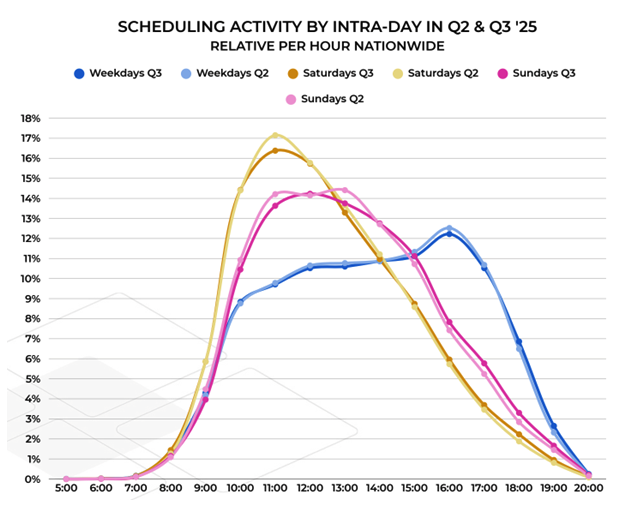
As you can see in the chart below, a large chunk of showings are scheduled for 5 p.m. or later—21% on weekdays 5 p.m. and 8 to 10% on weekends. Self-showings provide accessibility for folks who can’t afford to spend their workday touring properties.
 Source: ShowMojo Q3 2025 Data Talk
The Traditional Approach — When to Stick to In-person
To create urgency
As a prospective tenant, it’s one thing to be told there’s a lot of interest in the unit you’re viewing. It’s another thing to see that interest in-person.
Forever Rents has shown this out by leveraging group tours during the latter stages of lease-ups. The company’s owner, Boot Levinson, said, “We found group tours have significantly bumped up the urgency. When five people are looking at the same time and we’re saying this one is the only one left at this price. We might have three of the five applying right then and there.”
If security is a known issue
OCF Realty is one of Philadelphia’s largest property managers. Kass Management Services manages over 400 multi-family properties in Chicago. Neither of them use self-showings.
For them, the perceived security risk and access issues in these densely populated cities is not worth the benefit of self-showings.
For specialty property management
Property managers who occupy a specific niche — managing luxury rentals, 55+ communities, student housing, and other specialty properties — tend to stick to self-showings.
These populations and units require in-person assistance to reduce liability and meet service expectations.
A Technology Platform to Enhance Any Approach
ShowMojo has become synonymous with self-showings, but our platform is built to accommodate any showing style.
Whatever showing strategy you use, ShowMojo can make it faster and more efficient. Schedule a demo to find out how.