
Data Talk Recap: Market Insights Q2 2025
We just wrapped up another Rental Market Data Talk, our quarterly deep dive into the trends, shifts, and signals coming straight from millions of listings, leads, showings, and leases across the U.S.
Unlike traditional reports, this isn’t guesswork or media spin. This is real-time data, pulled from our Leasing Automation platform that property managers across the country rely on every day. We’re here to give you the edge: smarter leasing decisions, faster conversions, and lower vacancy rates.
Where This Data Comes From?
All insights in this report are drawn directly from ShowMojo’s end-to-end Leasing Automation platform, which is built to reduce administrative overhead while giving managers complete visibility into the leasing lifecycle.
Since 2017, we’ve tracked over 1.2 million individual rental units, 22 million showings, 72 million leads, and 600 million communications. This isn’t a sample—it’s a nationwide snapshot covering everything from high-rise urban apartments to rural single-family homes. That’s what makes it one of the most statistically significant views of the rental market available today.
Rental Trends in Q2 2025: What Changed?
Days on Market Are Climbing, but with a Twist
After more than two years of cooling off, the rental market is finally showing signs of balance. In Q2 2025, the average days on market grew by just 8% year-over-year, down from 11% in Q1. That slower rate of increase points to stabilizing demand and improving leasing efficiency.
Lead and Showing Volume Are Down, But Conversions Are Up
There were fewer leads and showings per listing this quarter, but those interactions were more meaningful. Leads per listing fell 19% (now averaging 40), and scheduled showings declined 6% (down to 22). Yet, the conversion rate hit a record 56%.
This signals a welcome shift for property managers: less time wasted on unqualified leads, and more leases signed from fewer showings.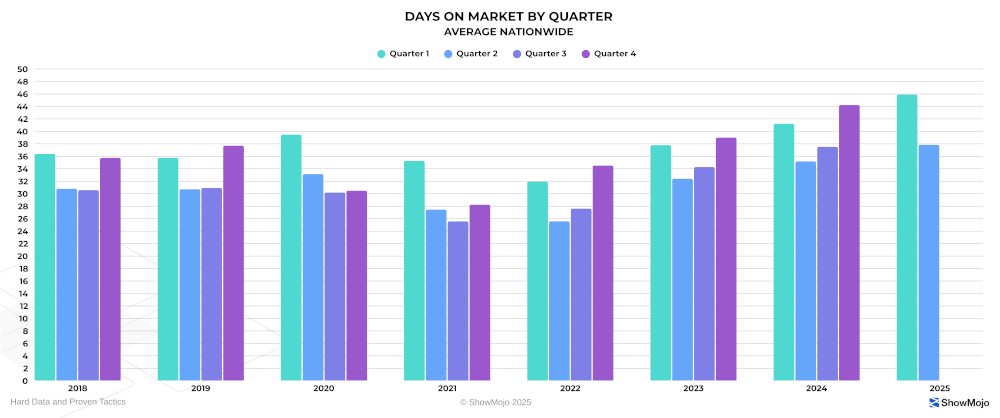
Premium Rentals Are Now Leading the Market
High-end rentals are driving the current momentum. Units priced over $1,500 not only gained market share but also leased faster than budget rentals. Meanwhile, demand for lower-priced units ($500–$1,500) has declined.
This shift could be due to increased demand for upgraded amenities, or a simple undersupply of quality housing options in the higher price range. Either way, premium listings are winning.
Rents Are Finally Rising Again
After five flat quarters, rents jumped — a lot. Q2 2025 saw a 96% quarter-over-quarter growth and a $100 year-over-year increase, making it the third-largest quarterly rise we’ve recorded.
For property managers and owners, this rebound provides some breathing room, but it also makes pricing accuracy more important than ever.
Getting Pricing Right Is Still Everything
Overpricing continues to hurt more than it helps. Even a $50 increase above market rate can lead to a full month of vacancy. And if you end up needing a rent reduction, expect your time on market to double.
Geography also matters. Rural units lease 1–2 days faster on average. But urban units perform best overall, with conversion rates jumping from 39% in 2018 to 57% in Q2 2025. This is where automation, data, and pricing tools really shine—they help fine-tune strategies at the unit level.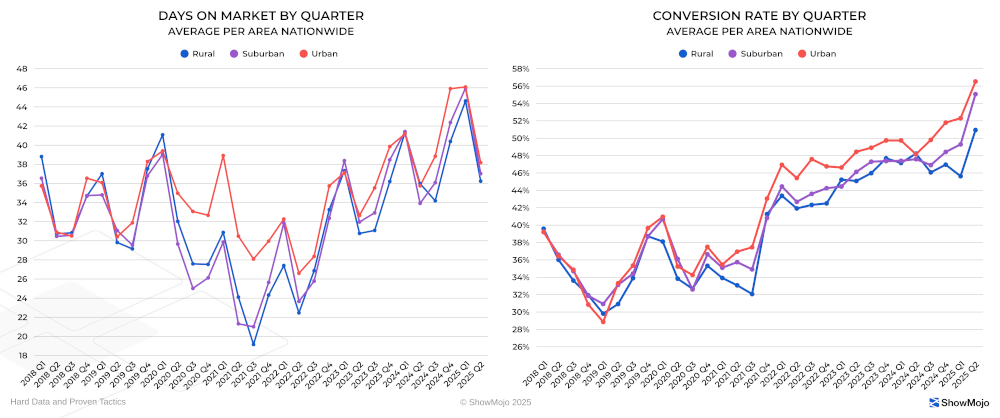
Macro Trends You Can’t Ignore
We’re still seeing elevated housing supply across the U.S., but projections show a slowdown in new deliveries between 2026 and 2028. That’s due to rising construction costs, high interest rates, and tighter financing options.
Homeownership remains out of reach for many renters, keeping demand strong in the rental space. Vacancy rates have stabilized between 5–7% nationally. Still, there are headwinds: inflation, slowing job growth, and ongoing geopolitical uncertainty are all weighing on renter behavior.
The takeaway? You can’t control the economy, but you can control how efficiently you operate.
What Makes Listings Perform? Smart, Clean, Straightforward Listings Win
Based on millions of interactions, here’s what works:
- Keep titles short and catchy (under 60 characters)
- Include 2–10 standout features in your property details
- Use descriptions between 51 and 400 words
- Be transparent about deposits and policies
These listing habits reduce back-and-forth with prospects and drive faster decisions. It’s not about saying more — it’s about saying the right things.
More Photos ≠ More Leads
Surprisingly, listings with more than 26 photos attract fewer leads. On average:
- 0–10 photos → 25 leads
- 11–25 photos → 24 leads
- 26+ photos → 20 leads
The key is quality, not quantity. High-resolution, well-lit, and accurately staged images work best. Consider using AI tools to clean up or virtually stage rooms — especially in vacant units.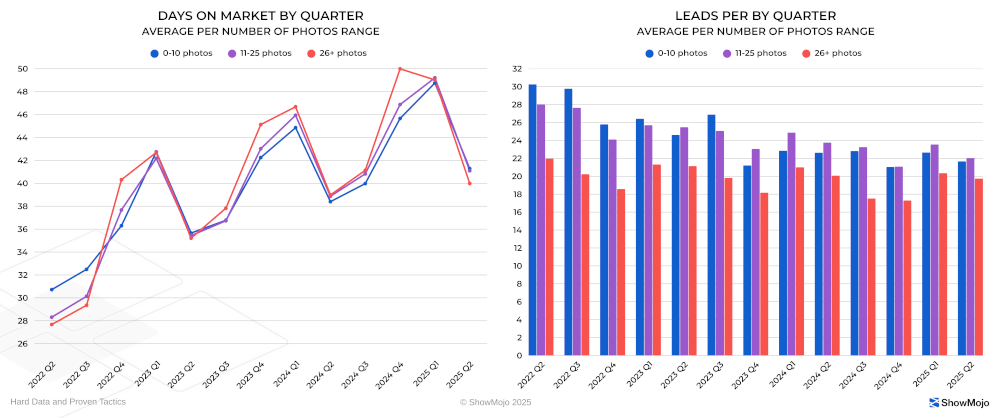
Pet-Friendly and Watermarked = Trustworthy
Renters are more likely to engage with listings that appear transparent and secure. Listings that allow pets get an average of two more leads. And those with watermarked photos lease faster — likely because they feel more trustworthy and professional.
These subtle signals can make a major difference in lead quality.
Understanding Renters’ Habits & Desires
Renters are browsing until 10pm and booking showings outside of business hours. Monday through Wednesday are the busiest days online, while Saturdays dominate for showings. Sunday, by contrast, is the slowest day.
Same-day or next-day bookings have a 70% completion rate, while showings booked two weeks out drop to just 12%. That’s a major argument for automation — prospects want flexibility, and leasing teams need tools to keep up.
Screening: ID Verification is Back
Screening and ID verification tools are back on the rise after five flat quarters. Pre-showing questionnaires work best when they’re brief — keep them under 20 questions to avoid drop-offs.
ID verification may add about two days to the process, but it’s worth it. These tools protect against fraud and save your team from spending time on unqualified leads.
Self-Guided Tours Are Now Essential
Self-showings are no longer a niche option. They now account for 1 in 3 scheduled tours. Listings that offer them see 20% more tours and convert better, largely because they allow renters to tour on their own time.
They’re especially popular after hours and on weekends. Just make sure to use smart locks, ID verification, and geofencing, and restrict these tours to vacant units only for safety. 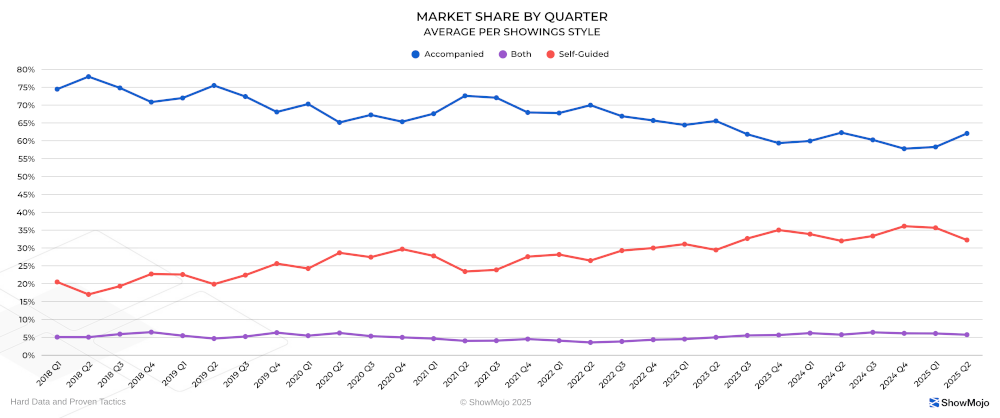
Best Practices for Property Managers in 2025
In today’s unpredictable market, success comes down to a few simple but powerful strategies:
- Price accurately from day one — don’t rely on guesswork
- Use automation to streamline communication and scheduling
- Offer self-guided tours to capture more serious prospects
- Use AI for listing optimization and virtual staging
- Be upfront about deposits, pets, and policies — renters appreciate it
Managers who embrace data and automation lease faster, reduce costs, and stay ahead of their competition.
Final Thoughts: Your Leasing Advantage Starts with Data
The Q2 2025 data paints a clear picture: the market is shifting quickly. Premium units are leasing faster. Conversions are at record highs. And self-guided tours are now the norm, not the exception.
Automation and smart strategies are no longer “nice to have.” They’re critical. The property managers who lean into this shift will spend less time chasing leads — and more time signing leases.
Curious about what some of these efficiency boosters look like in action? Schedule a demo of our software today.
Get Leasing Automation tips and solutions right to your inbox.