

How Self-Showings Can Help You Lease More Properties
Self-showings are a contentious topic in the PM industry, mainly because of security concerns. But like most contentious debates, a lot of nuance gets lost.
We think it’s high time we break this down — the good, the bad, and everything in between.
We’ll cover:
What is a Self-Guided Property Tour?
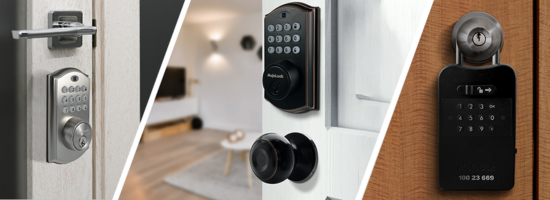
A self-guided apartment or house tour is a short, unaccompanied visit to a rental unit that prospective tenants use to determine whether they want to lease.
The self-guided tour, also called a self-showing or unassisted showing, allows the prospect to view the unit at their own pace, with no pressure from a leasing agent.
Self-guided tours can include some virtual assistance. For example, one of ShowMojo’s customers, Annapolis Property Services (APS), allows prospective tenants to tour units by themselves while on the phone with an APS leasing agent.
Are Self-Showings Right for Your Properties?
If your labor savings from self-guided tours offset their costs, self-showings will be a net financial benefit.
In practice, that labor savings threshold typically occurs when self-showings enable you to avoid the next hire. This brings us to:
The Official ShowMojo Self-Showing Rule of Thumb
To make the switch worthwhile, self-showings need to save you 60 to 80 hours per month, the equivalent of one half of a full-time employee’s workload.
The Quick and Dirty Break-even Analysis
Given this rule, all you need is a quick and dirty breakeven analysis to determine if self-showings are financially viable.
To estimate the break-even point for self-showings, first estimate the following for your portfolio:
- Vacancy rate
- Tours per vacancy
- Minutes of labor per attended tour
- Fraction of attended-tour labor that self-showings remove
Then, plug these figures and your total doors under management into this formula for a rough calculation.
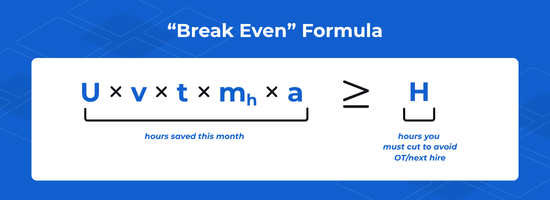
- U = doors you manage (known)
- v = vacancy rate (fraction)
- t = tours per vacancy
- mh = hours per attended tour (incl. travel/coord)
- a = share of attended work self-showings actually remove (0-1)
- H = hours/month you need to eliminate to “break even” on staffing (e.g., avoid 0.5 FTE or overtime)
If the total on the left side of this equation is greater than or equal to 60, you can be fairly certain that self-showings will make your leasing process more efficient.

The Costs of Self Showings
The average leasing associate salary in the United States is $42,323. So if self-showings allow you to avoid paying even half of that, you’ll come out ahead.
You don’t need a full-on cost-benefit analysis to tell you that.
Even so, it’s worth exploring the costs, risks, and benefits of self-showings.
Self-showing costs include ongoing software and hardware expenses, as well as one-time setup costs.
- Software costs: include subscription and per-tour costs that depend mainly on capabilities and integrations.
- Hardware costs: vary widely depending on how many access devices you need and whether you plan to invest in an alarm system or security cameras.
- Setup costs: include setting up new processes, communicating with owners, printing signage, and paying one-time setup fees for hardware and software.
To give you a concrete example, ShowMojo provides everything you need to run self-showings for $0.50 to $1.30 per unit and $3.50 to $5.00 per month per MojoLock or MojoBox, depending on the plan you choose. For more details, check out our pricing page.
The Risks of Self-Guided Tours
Self-showing detractors say that self-showings are too risky because they invite squatters and scammers. There’s truth to this. Without enhanced security measures, self-showings are risky, just as guided showings are.
Fortunately, just about every self-showing tool on the market has some level of security built in, though their capabilities vary widely.
For example, ShowMojo keeps a current database of known scammers and uses machine learning to stop or cancel high-risk showings.
Additionally, MojoLocks and MojoBoxes replace easily compromised single access codes or keys with highly customizable, easily revokable, and time-restricted codes.
(And that’s just scratching the surface of ShowMojo’s capabilities.)
Of course, beyond built-in features, smart PMs know to use common sense and professional judgment to pull back on self-showings when necessary.

The Dark Side of In-Person Showings
The other nuance that gets left out of the self-showings vs. guided showings debate is the risk of in-person showings. Scammers and squatters existed long before self-showings.
And even if guided showings reduce property risk, sending agents to meet strangers is a safety risk. In 2024, 18 percent of male agents and 29 percent of female agents reported having feared for their personal safety.
Put simply, risk is relative, and no showing is risk-free.
But with self-showings, you can eliminate personal risk, manage property risk, and scale your business to heights it could never reach with only guided showings.
To give secure self-showings a try, or just to see how it works, schedule a demo with ShowMojo today.