

Portable Screening Reports: What Property Managers Should Know
There’s a growing patchwork of legislation on portable tenant screening reports (PTSRs) that may remake the screening process for landlords.
Six states, including Colorado, Rhode Island, Illinois, California, Maryland, and Washington, have legislation on the books for PTSRs.
And as of this writing, the National Apartment Association is currently tracking eleven portable screening bills across various states.
Penalties for non-compliance can be steep—up to thousands of dollars. And confusion among prospective residents can harm your reputation if you don’t clearly communicate your policies on PTSRs.
Unfortunately, because these are relatively new laws, that’s easier said than done.
What a PTSR must contain to be considered valid, how long they’re good for, whether landlords must accept them, and other factors differ greatly from state to state.
We wrote this post to make sense of this morass. In the sections that follow you’ll find:
What is a Portable Tenant Screening Report?
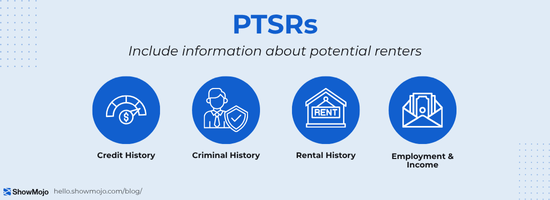
A portable tenant screening report, also known as a reusable tenant screening report, is a document that contains the information property managers need to evaluate a potential tenant’s:
- Credit history
- Criminal history
- Rental history
- Employment and income
Like a traditional screening report, PTSRs also help landlords verify a prospect’s identity.
Prospective renters can purchase these reports and reuse them for multiple rental applications within a set time window.
In theory, this screening report is meant to replace the need for each landlord or property manager to run their own, separate background and credit check every time a renter applies for housing.
That way, renters don’t get stuck paying multiple application fees for homes they may or may not be approved for.

How Portable Screening Reports Vary, State to State
Portable tenant screening reports vary from state to state. This variation includes:
- Required contents for the report to be considered valid
- How the PTSR must be delivered to the landlord
- Exceptions for certain types of renters
- Recency windows (i.e. how fresh the report must be)
- Whether landlords must accept a report
This table provides an overview of each state’s policies on PTSRs. But we recommend you familiarize yourself with the specifics of your state’s rules using the links provided.
| State | Required contents | Acceptance | Validity |
| California | Name, contact info, verification of employment, last known address, results of an eviction history check; plus the report must prominently state the “current-through” date. (2024 California Civil Code) | Optional | 30 days |
| Colorado | Name, contact info, verification of employment & income, last-known address, and for each prior-residence jurisdiction: (i) rental & credit history report* and (ii) criminal history record check; also must state the “current-through” date. (Colorado General Assembly) | Mandatory (with exceptions) | 60 days |
| Illinois | Name, contact info, verification of source of income, last known address, eviction history results; and must state the “current-through” date. (Illinois General Assembly) | Optional | 30 days |
| Maryland | Credit report; for each prior-residence jurisdiction: (i) comprehensive criminal history records check (federal/state/local) for 7 years and (ii) comprehensive eviction history for 7 years; plus employment & income verification, current address, and rental history. (Maryland General Assembly) | Optional | 30 days |
| Washington | Consumer credit report, criminal history, eviction history, employment verification, address & rental history (Washington State Legislature) | Optional | 30 days |
Rhode Island is a special case in that its portable screening only applies to criminal background and credit checks.
So if a prospect provides a background and/or credit check, landlords in Rhode Island cannot charge for these documents. More information on Rhode Island’s portable screening laws.

How to Stay Compliant with PTSR Regulations
Publish a clear, written policy and train to it.
If you operate in optional-acceptance states, state publicly whether you accept PTSRs. If you accept (or must accept), educate staff on what counts as “valid” and how staff should verify authenticity.
Follow state fee rules.
If a valid report is provided, most states prohibit charging any kind of application or screening fee. Configure your online application process so fees are automatically suppressed when a PTSR is used.
Build a recency and attestation checkpoint.
Add a checkpoint in your application process for PTSRs that requires prospective tenants to confirm (in writing) that no material changes have occurred since the PTSR was generated. And make sure your PTSR verification process confirms that the report is within your state’s required recency window.
Address state-specific exceptions.
In Colorado you’re generally required to accept a compliant PTSR, but there are narrow exceptions—e.g. when you accept only one application fee at a time for a unit and refund fees to declined applicants within 20 days.
Document such exceptions in your SOP so teams apply them consistently.
Stay in the know
Assign ownership for updates. Designate one person to track legislative changes and update policy, disclosures, and training on a set cadence.
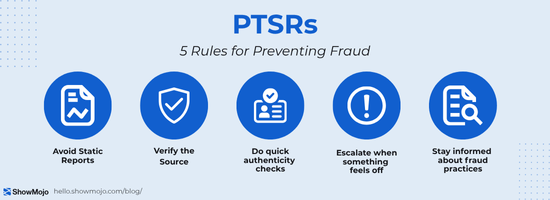
5 Rules for Preventing PTSR Fraud
Apply every step uniformly to all applicants to avoid disparate treatment concerns.
1. Avoid static reports: Require links or portal access with a report ID you can validate. Never accept screenshots and avoid static PDFs.
2. Verify the source: Confirm the report provider is operating as a consumer reporting agency or a compliant third-party service.
3. Do quick authenticity checks on every application: Match basic info (legal name, birthdate, SSN) across the application and the report. Confirm the “current-through” date is within the state’s window and require a no-material-changes attestation. Cross-check prior addresses and employer names for plausibility.
4. Escalate when something feels off: If signals don’t line up, run deeper verification: bank-connect or payroll-connect income checks, direct employer calls using publicly sourced numbers, or a fresh local-court records check.
5. Stay informed about fraud practices: Fraud schemes are in constant flux—in the next section, you’ll find a couple of resources to stay informed.
(While we’re on the subject of fraud, check out our resources on preventing application fraud and leasing scams.)

How to Stay Informed
States, tenants, property managers, and credit reporting agencies are still figuring out the new landscape of PTSRs. In fact, Colorado updated its PTSR legislation just one year after it was established, perhaps due to its bumpy rollout.
To stay up to date on this changing landscape, here are a couple of resources to consider:
- The National Apartment Association provides this useful tracker which helps you stay up to date on any pending legislation. Just filter by state/“portable screening report” to see active bills.
- Create a Google alert for: “portable tenant screening report”, “reusable tenant screening report”, and “comprehensive reusable tenant screening report” and the names of the relevant state legislature:
- Colorado: “HB 23-1099”, “HB 25-1236”
- California: “Civ. Code 1950.1″
- Illinois: “765 ILCS 705/25”
- Maryland: “RP 8-218”
- Washington: “RCW 59.18.257”.

Make PTSRs Low-friction and High-confidence with ShowMojo
Why ShowMojo for the PTSR era:
- PTSR-ready application flow: Request the right docs, collect real signatures, and opt to suppress screening fees (or not).
- Built-in verification: Instant-on screening, document verification by text, and voucher-friendly screening questions.
- Fraud controls that actually help: Experian Passive Authentication, credit-card validation for lockbox showings, location verification, aggressive watermarking, blacklist tools, and pre-showing restrictors to filter unqualified prospects before they hit your calendar.
- Operational confidence: Centralized audit trails and automated workflows so your team follows the same steps every time.
Accepting portable/reusable reports doesn’t have to slow your leasing. ShowMojo gives you a ready-made workflow to verify identity, collect self-reported income, and keep airtight records, automatically.