

Fewer Leads, Higher Stakes: 9 Best Ways to Optimize Rental Listings in Q1 2026
We started out the year by looking back — our recent Data Talk recapped our customers’ performance in Q4 2025.
One finding stood out: across the industry, lead volume fell to its lowest point since we started gathering data in 2018, but our customers’ conversion rates didn’t drop with it.
ShowMojo customers had an average lead-to-scheduled-showing conversion rate of 52% in Q4, and their average lead-to-completed-showing conversion rate was 31%.
This wasn’t a one-quarter anomaly. Conversion rates were even higher earlier in the year.
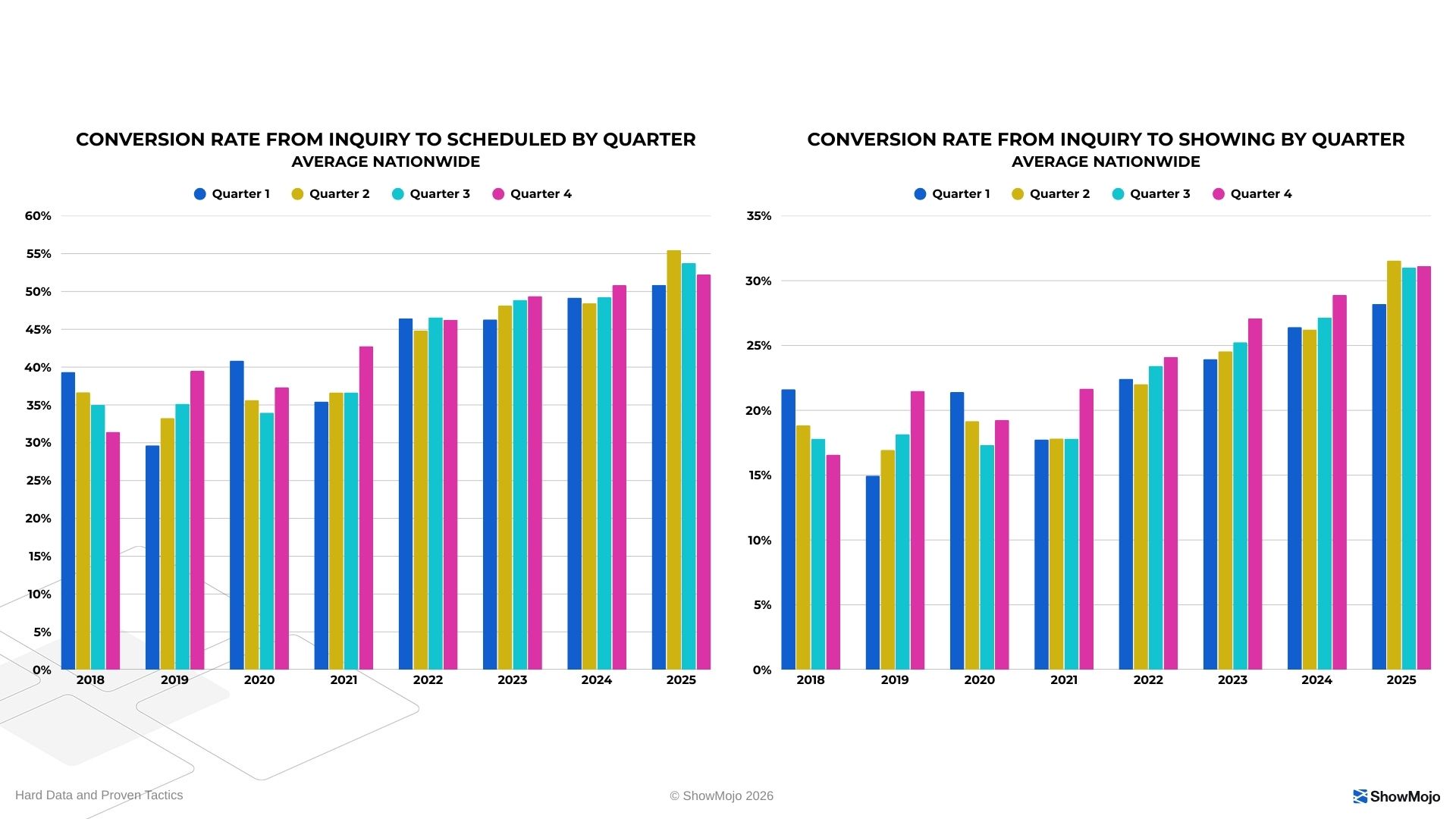
Our takeaway: when demand decreases, speed wins.
ShowMojo’s leasing automation helps our customers outperform the competition by removing friction, improving speed, and protecting conversions.
But our data showed that conversion has multiple levers. Specifically, pricing and listing optimization were major factors in conversions and days on market.
In this recap we get into the details, but if you’re in a hurry, this checklist summarizes the takeaways.
TL;DR: 9 Ways to Optimize Rental Listings in 2026
- Set a price-check reminder on day 8 of every listing.
- Agree on pre-approved rent reduction bands with owners.
- Include a title that’s up to 60 characters long.
- List 2 – 10 unit details.
- Write a description that’s 51 – 400 words long.
- Include 11 – 25 high-quality photos.
- Use aggressive watermarking on photos.
- Consider adding video or 3D tours to listings for difficult-to-move units.
- Clearly outline pet policies.
Pricing Sets the Floor for Performance
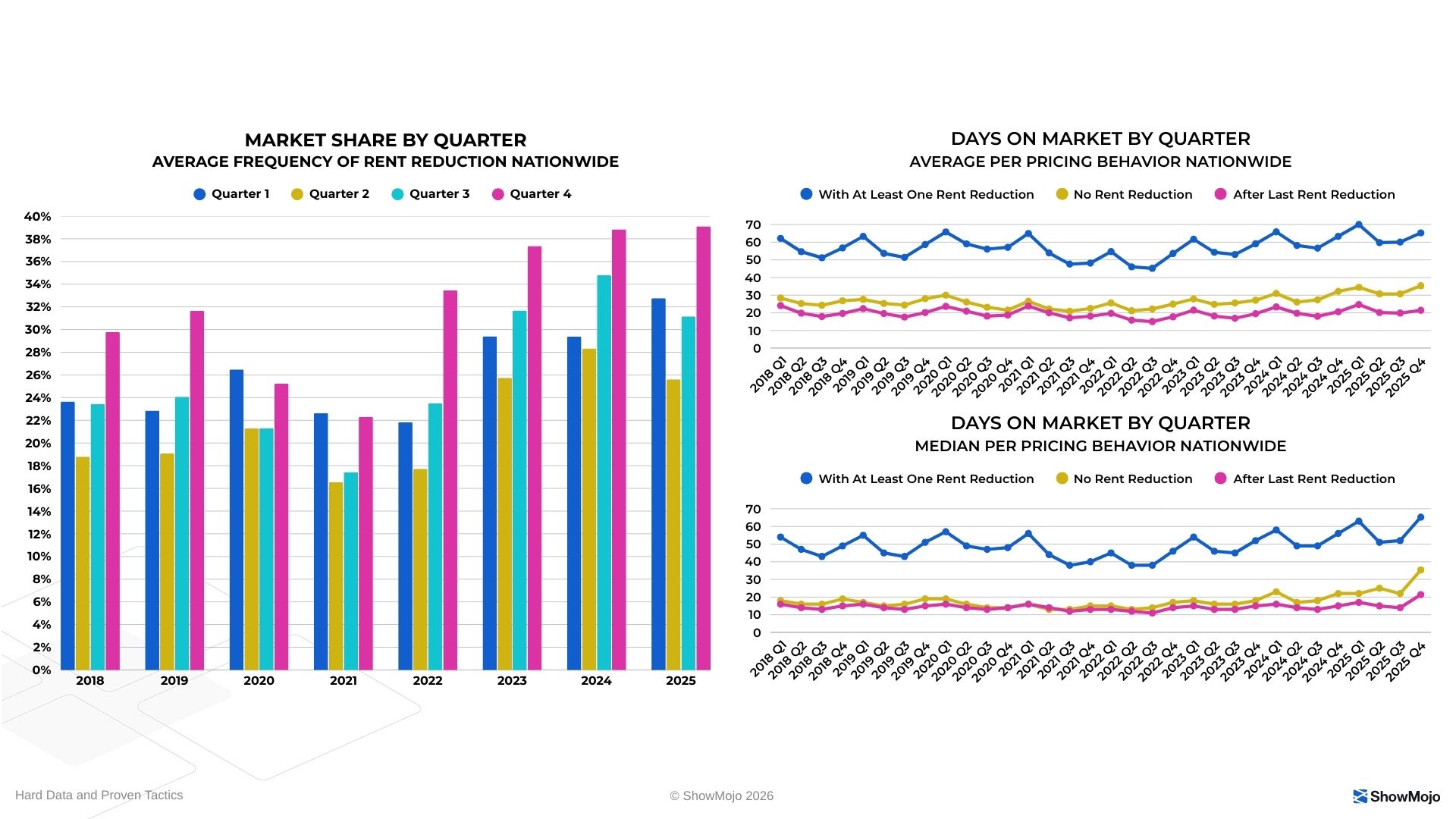
In Q4 2025, rent reductions were at an all-time high — 39% of units reduced their rents — after climbing steadily in every Q4 since 2018. Fortunately, Q2 has had the fewest rent reductions every year in our data set, so relief is likely on the way.
But pricing is a key factor that prospects look at when considering a unit, so getting it wrong can mean losing revenue if units are sitting empty.
Our data shows that after its final rent reduction, a unit is rented in about 16 days. Listings that were priced right from the beginning rented in about 24 days. That eight-day difference is your decision window.
Set a reminder to check a unit’s performance on its eighth day of listing. Look at the leads, tours, and applications it received per day on market. If these are lower than desired, adjust the price.
Pro tip: Agree on pre-approved reduction bands with your owners, so that you can adjust pricing without needing to wait for last-minute approvals.
Listing Optimization: 7 Things That Actually Move the Needle
In a tight market, the small details matter. So we reviewed our customers’ listing practices and found what’s working best.
1. Listing Title Length
The biggest lesson we learned about titles? Your listing must have one.
Listings without titles performed worse on every metric we measured. Up to 60 characters in your listing title is the sweet spot, but it’s all right to have longer titles if you have more information to include. Just make sure there’s a title.
2. Unit Details
We also looked at how many details, or features of a unit, are highlighted on the best-performing listings. We found that 2 – 10 details total perform best. Listings within this range saw a nearly 12% increase in both lead-to-scheduled-showing and lead-to-competed-showing conversions.
3. Listing Description Length
The optimal listing description length is 51 – 400 words. Listings in this range generated 37% more leads and 13% more scheduled showings.
Listing descriptions should use descriptive language that delivers the unit’s relevant information and helps the prospect picture themself in the space.
AI tools can help you hit the 51 – 400-word sweet spot, but your description’s performance still depends on accuracy and relevance. Make sure to carefully review AI’s output to ensure there’s no false information.
4. Image Count
Listings with 11 – 25 photos performed best overall, seeing 13% more leads. But photo quality is even more important than the number of images you have. A listing with 10 high-quality photos is likely to perform better than a listing with 25 poor images.
High-quality photos make your listing stand out, so they’re a great place to start when enhancing underperforming listings.
5. Photo Watermarking
We compared listings with no watermark, mild watermarks (small in the corner of photos), and aggressive watermarks (information displayed across photos). Aggressive watermarks performed best in most of the metrics that we measured.
When your instinct might be to optimize for prettier photos, focus on real-world outcomes instead. The data shows that an aggressive watermark performs best. Plus, watermarking helps prevent rental scams.
6. Multimedia Listings
Most of our customers use photos to showcase their units in listings, but some use video or 3D tours, so we looked at the performance of those elements, too.
We found that both tactics generate interest at the top of the funnel. Video generated almost 14% more leads than listings without video, and 3D tours generated 16% more leads than listings without.
But that doesn’t mean every listing needs a video or 3D tour, which usually require more up-front investment than photography. Instead, think of video and 3D tours as tools that can help generate traffic for underperforming units.
7. Pet Policies
More and more renters are looking for pet-friendly units. We saw that listings for cat-friendly units received 15% more showings, and dog-friendly units received 11% more showings.
Regardless of whether you allow pets in your units, make sure that your policies are clear in the listing, so prospects aren’t wasting their time (or your team’s time) inquiring about your policies.
High-performing listings are deliberate, with enough detail to qualify and enough clarity to convert.
What Property Managers Should Do Next
Lead volume is down, and that’s not going to change overnight. What can change is how efficiently you convert the leads you already have.
Our Q4 data makes one thing clear: teams that move faster, price smarter, and remove friction across the leasing journey are the ones that win.
In 2026, winning prospects won’t come from chasing more leads. It will come from building a leasing experience that respects prospects’ time, eliminates unnecessary delays, and pairs automation with human-led lead nurturing.